Welcome

Please feel free to comment, correct me if I am wrong, or provide helpful tips of any kind


Nature in it's glory

Nature in it's glory

Nov 15, 2011

The unintentional side effects of poison

Common Raven

Many local businesses have resorted to using poison to control pest species such as Pigeons and Rodents.   The reasons for doing so vary from loss of property and profit, to health concerns, and droppings leaving an unsightly mess on the sides of the buildings and rooftops.   However, the use of poison to control these pest species has a very unfortunate side effect that very few people mention, witness or even understand.


The poison that is used does not just target and kill the intended pest species.  In fact it can, and does act like a disease, which spreads to include other species.  Take the Raven for example.  Not only do local Ravens hunt Pigeons for food in winter, thus helping to control their population, they also eat carrion.  Their doing so helps prevent the spread of disease, but has now come with deadly consequence.  Just lately I was told by a friend that the body of a Raven had been found in a Garden Center without wounds, or other indication of injury that may have caused it's death, and this was not the first time this year.  While the Garden center is now closed, they still store seed and so, still implement pest control measures.
Peregrine

A couple of days ago I came across this little bird, in the photo below, outside of a business, near that same garden center.  It was a very sad species introduction for me.  As you can see there are no wounds, there is also no window nearby, ruling out a window strike.  My best guess, since this is a seed eating species, is that he got into some of the poisoned seed left out for the Pigeons on the rooftop.  
Common Redpoll male
Carrion eating species of birds and finches are not the only species to be affected.  Some of the poison that is left out for pest species to consume, is slow acting and creates horrible suffering.  Once the poison takes effect, the creature cannot move very fast or very far.  I have seen this many times, when I worked in a warehouse that stored and sold grain and seed products.  The result is that the poisoned creature can often be found out in the open somewhere between the location of the poison and a place of safety.  This leaves them vulnerable to predators such as the Merlin below, a Peregrine Falcon, an Owl or even a pet cat.

Family cat
While the predators may then instantly relieve their suffering, they in turn will suffer and die, when the Rodent or Pigeon is consumed.  Their bodies, if not left to decompose, will eventually be discovered and consumed by one of the many carrion eating species of wildlife.  If they do not consume the dead or dying creature themselves, as might be the case during the breeding season, then an Owl, Raven, or Merlin will feed the poisoned pest species to their mate, or their young, killing them instead.

Merlin
While I know that this was not intentional on the part of the decision makers involved, the use of poison as pest control measure has created a very bad, very indiscriminate cycle of death for many wildlife species that needs to be stopped.   However, the sad truth is, this local community isn't the only one to use poison to control pest species populations and eliminate health threats.  Poison has been used for many years by communities the world over.  Are there alternatives?  More in another post.

Susan


Nov 9, 2011

Defying Gravity

Going Down


One of the reasons I will never tire of watching birds is the many things that birds are capable of doing.  The White-breasted Nuthatch is one of my favorite small birds to watch, if I get lucky enough to have one occupied with foraging at a single tree for any length of time, that is.
 
White-breasted Nuthatch just hanging on
As a species they seem to enjoy walking down the tree head first.  Sometimes they walk down in a quick spiral, stopping now and again to swallow a bug.  This one, however entertained me by showing off his strong legs and feet, and defying gravity altogether as he did so.  He walked along the underside of the branch, taking his time and foraging as he went.  Then he just dropped off.

Viewing the world upside down
Looking for bugs

His little wings spread and he was gone in a blink.

Enjoy,
Susan

Nov 4, 2011

Fall Flames

Northern Flicker in part silhouette


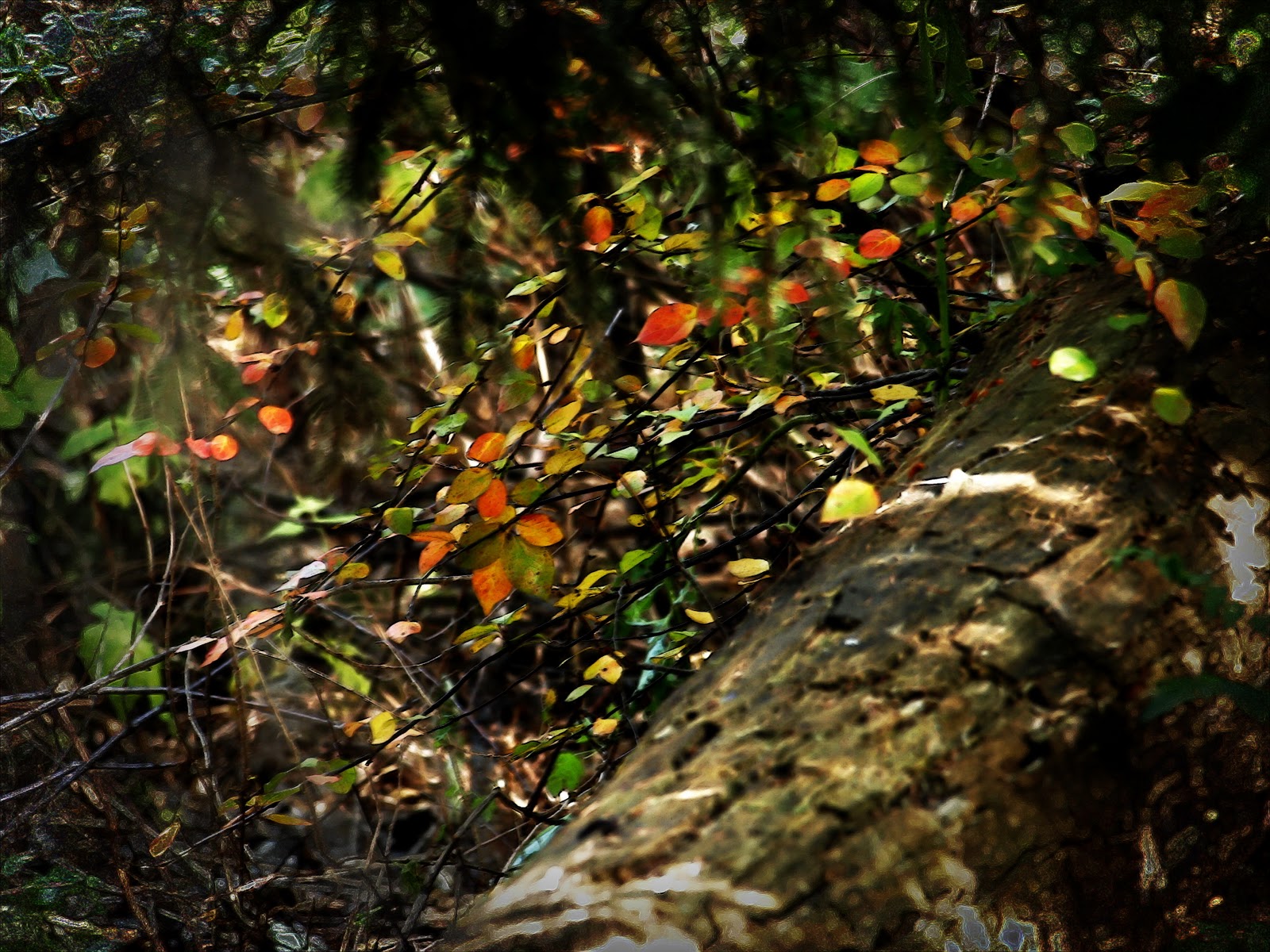
The mind's eye sees more than it's physical counter part picks up.  This can include the brightness and contrast of color, details on the wings of a bird, or the slightest motion.  A camera can help to capture what the physical eye has missed.  In this post I thought I would share some of my favorite photos from this fall.  All but one of these images are modified to emphasize the natural beauty which prompted me to take the photos.

Color flow
Cascade of flame

Sometimes the light is just right to help capture that image on camera, and at other times the natural mix of colors help to frame a momentary scene almost perfectly.

Common Yellowthroat


White-breasted Nuthatch
Golden Flame

Enjoy,
Susan

Oct 27, 2011

Bird identification and the color of legs, feet and bill

American Black Duck


          In order to identify a bird accurately many things need to be taken into consideration, such as body, bill, wing and tail shape,or eye stripes, crests, spots and streaks, color etc. Some birds however are especially difficult to distinguish from other species of birds, either because they appear to be almost identical to another species, or they have very few identifying field marks.

          This is where the color of a bird's feet, bill or legs can come in handy.  Some birds have very bright and colorful legs, like the American Black duck and the Lesser Yellow legs, and some have lightly colored legs, such as pink, gray and even green.  The same holds true for bills and feet.

Lesser Yellowlegs
          With the more difficult to identify species, the coloring of legs, feet and bill can make positive identification of a species possible.  The Dark-eyed Junco, for example, has an apparent twin at first glance.  It's name is Black Phoebe and it has the same light and dark color pattern.  However, they can be separated.  Although I do not as yet have a photo of a Black Phoebe, the Black Phoebe has a black bill and legs, while the Dark-eyed Junco has a pink bill and legs.


Dark-eyed junco on fence
Dark-eyed Junco


          Herons are another family of species that it are sometimes difficult to distinguish accurately, especially since several species have a white morph variant in the family, like the Great Blue Heron and the Reddish Egret.

Egret
           The Snowy Egret has yellow feet and black legs, and is affectionately called Yellow slippers in some parts of the world.  The Great Egret, on the other hand, has a yellow bill, and black feet and legs.  A white morph Blue Heron has a yellow bill and pale legs, and the Reddish Egret in white morph has a dark or bi-colored bill.
          Notice that I simply labelled the photo above as Egret.  This is because the image is unclear and I do not have sight of the whole bird.  Although it seems to have a bi-colored bill the, bird is partly in shadow, and I can't see the legs accurately at all, so it makes it difficult to tell.  Unfortunately it is the only photo I have and my camera equipment at the time did not produce the greatest images.  Hopefully I will see this bird again in the future.

Enjoy,
Susan

Oct 20, 2011

Alberta Birds: October

The trees are almost completely bare, although the flowers in my flower beds are still valiantly trying to produce more blooms.  This means that lately I'm not seeing very many birds.  Even the Juncos and White throated Sparrows seem to have flown, although I still hear Geese flying over the house at night as they continue to migrate.

The birds that are left have been mostly quiet when I have gone out on bird watch, and seem to stay hidden.  This is a tense time of year for the bird species that do not migrate, since there are many more predators seeking to feed themselves as they follow their prey south, as well as predators who simply take advantage of the lack of cover for these birds.
Northern Flicker
On the bright side, this is a perfect time of year to see Woodpeckers.  I'm also hoping to see species of  Hawks which I don't usually see in the area, which is why I continue to go out on bird watch.  However, this week's sightings makes for a very short list, but include one lone Mallard duck and a Solitary Sandpiper.

Solitary Sandpiper at dawn
Blue Jay
The photos I present here represent the bird species on that list.
Murder of Crows


The Crows in the tree above were actually only a few in the huge murder that I saw.  I have noticed over the years, that whenever large numbers of crows gather in the fall, the winter that follows is usually very cold.  I'm really hoping that I'm wrong, since I don't enjoy winter much, and plan to go out more this winter in hopes of catching sight of bird species that might come down from the north to winter here.

Chickadee
Nuthatch

This time of year Blue Jays and Magpies are everywhere.  They are the only birds that are seen out in the open almost all of the time.  You will hear the House Finch and Nuthatch occasionally, but even they are unusually quiet.

House Sparrow


I caught this photo of a House Sparrow just as I headed for my front door, reminding me to fill my bird feeders and to purchase some suet to hang in the tree for wintering birds.  Please don't forget to do the same.


Enjoy,
Susan

Oct 15, 2011

One second with Nature: Oct

When I am out and about in nature I see a lot of wonderful, amazing and delightful things, plant-life, glimpses of scenery and/or creatures.   It just seems natural to me to share what I see and hope that you will share it as well.  The world around us in beautiful after all.

Gorgeous Rainbow

I thought I would begin with this rainbow, which symbolizes hope and promise.  As a child I always looked for a rainbow after the rain.  It made up for being cooped up inside at the insistence of my parents.
Enjoy,
Susan


Oct 13, 2011

New bird: a mystery for me

Fall
The forest is silent and feels empty, so it's kind of strange being out on bird watch, especially when you realize that the birds that were going to leave are surely all gone.  Sometimes there are stragglers though, and some birds coming  from the north might over winter here, or try to, because it is somewhat warmer.  Still, I was surprised when this week's bird watch outings presented me with both a new bird and a mystery rolled into one.

When I first saw this bird, perched at the top of a very tall tree in the distance, I thought it was a crow, after all Crows seemed to be numerous and everywhere at the same time at this time of year.  But there was something different about this bird that nagged me, so of course I had to start taking photos.  As soon as I began taking photos, I realized the bird's shape and posture was all wrong for a crow.  This bird's wings were too long, either that, or it's tail was shorter than that of a crow.  So I started circling the little forest to try to get closer to it and get some shots in better light.

New bird in the distance
New bird a little closer

I followed a small trail into the forest, through some brambles and under some bushes and trees to get to a little clearing, where I was hoping to have better light and a clear line of sight.  Here I took a few more photos, but the light still wasn't good enough and I decided I needed to get closer still.   Now in order to do that I had to be very careful where I put my feet, since there was no trail.  And that's when the bird decided to move to another perch.   Although I managed to keep him in sight, I missed the chance to get a photo of him in flight.  By this time I had myself nearly convinced that this might actually be a woodpecker of some kind., because his bill was long and slender, and it seemed to me, slightly curved.

Closer  view from below
New Bird calls  out
However, as you can tell from lower of the two photos near the top of this post, if you click to enlarge it, his tail is the wrong shape.  It doesn't have two points which would mark him as a woodpecker.   There was also the fact that he seemed to have yellowish, clay colored wings when viewed through the camera in the right light.

New bird on different perch
Assuming new posture

When the bird landed on his new perch, he was lower down and in somewhat better light, but that didn't help me identify him.  In fact it made things worse.  First off he was again further away and  a side view only served to confuse me more, since now he seemed to have taken on a reddish/purple hue, with a dark spot just under the throat which is lightly colored.  Or lighter than the rest of him in any case. He also had black or dark patches at the shoulder.  This is when I began to wonder if the bird's feathers were iridescent.


Just before the bird took flight again and I lost sight of him altogether when he dove down into the forest, I got the biggest shock of all.  This bird is bearded, as you can clearly see in the photo just above. He made  to sing, or otherwise use his voice to make himself heard, and the beard feathers stood out and away from his throat.  Now I could also see by his posture that his wings are clearly very long.  So what bird did I have recorded on my camera?   I went home and immediately searched all my favorite websites and all of my books, and came up empty.  Naturally, I am totally stumped. So if you happen to know what species of bird this might be please message me.  Thanks.

Enjoy,
Susan