Welcome

Please feel free to comment, correct me if I am wrong, or provide helpful tips of any kind


Nature in it's glory

Nature in it's glory

Oct 10, 2011

Guni4's photostream

song sparrow dP5141200P9295411-1Red winged black bird femalePicture 166 boat tailed grackle femaleP9245111-1 Admiralst thomas butterfly
P9254790 Sept 25 Tennesse warblerP9244850-1 yellow rumped warblerP9244828-1 mourning warbler femaleP9244792-1 White throated sparrowP9213909-11 (2  Says Phoebe)P9213801-11 (2 Says Phoebe)
P9184451-1 greater yellowlegsP9245070-1 painted ladyP9255338-1P9173302-1P9114065-1 Wilson's warblerP9114020-1 audubon's warbler
P9113948-1 chipmunkP9112543-11  American RedstartP9112496-1 (2 magnolia warbler)P9103381-1 bird1 warbling vireoP9103207-11  Common yellowthroatP8221162-1 Olive  sided  flycatcher
 As you may all know by now I love taking pictures of wildlife.  So I decided to upload some of my images to share.  Just follow the link below.
Guni4's photostream on Flickr.

Enjoy,
Susan

Oct 6, 2011

The trouble with young birds

Juvenile Downy Woodpecker


Bird watching can be challenging at times, but hey, if it wasn't, it wouldn't be any fun, and we wouldn't learn anything besides.  Having said that, I was lucky enough this year to see several different species of juvenile birds.  While most juvenile birds typically look like the female of their species, juvenile birds can make bird watching very confusing on occasion, because many don't look anything like their parents and/or can be easily mistaken for another species altogether.  

American Redstart Male
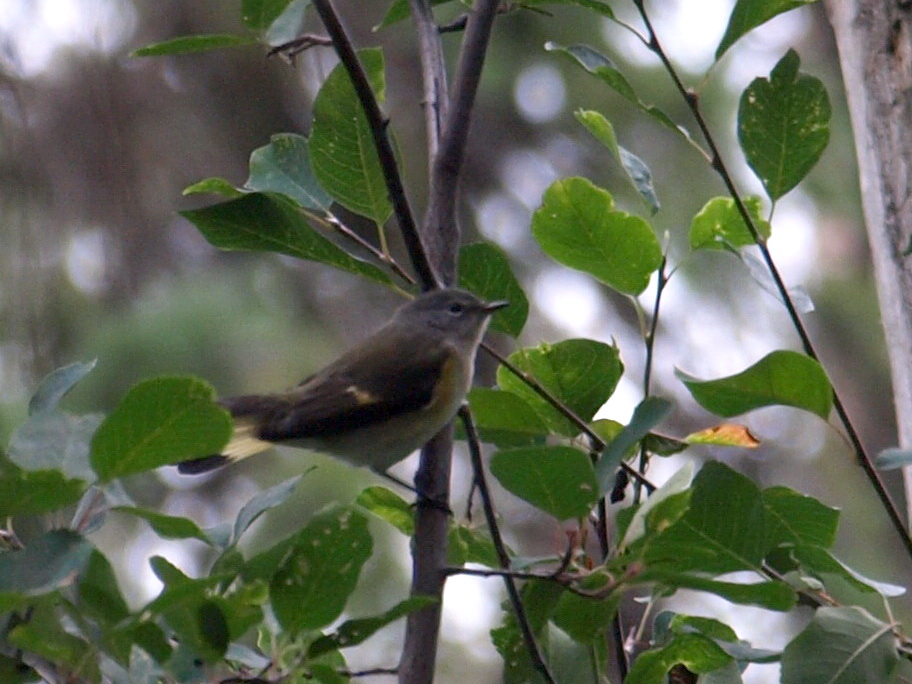
Take the American Restart for example.  This is a bird that caused me some serious confusion for quite some time, especially after I caught a juvenile on camera.  The male of the species is easily identified with his black and red coloring.  The female can be mistaken for another species because her coloring is so different from the male, yet so similar to that of other species of birds.   However she is also very unlike most other female birds,who are typically drab in color.  When you throw a juvenile into the mix, well, lets just say identification can become even more tricky.   Here are some photos.   Just click to enlarge them and you will see what I mean.

American Redstart Female
American Redstart Juvenile


Some juvenile bird species are not the least bit difficult to identify, like the Downy woodpecker at the top of this post.  Then there are those juveniles that can leave you puzzled, if only for a short time, unless you see them next to the adult. These do have some markings that are similar to the parent to help identify them.  The Cedar Waxwing juvenile below has the parental mask, as well as the beginnings of a crest to help identify him as a species.  However, they also have a darkly streaked chest and sides and their color is not quite the same as their parent's.  This can cause an identification mishap, if by chance you fail to see the mask, hear their voice, or notice the crest.
Cedar waxwings- adult and juvenile
Cedar waxwing juveniles
To make things really interesting, some birds are colored in their parents non-breeding plumage when young, or simply have a different  pattern of  markings and/or color  altogether.  If you have never seen the parent in non-breeding plumage this can be somewhat troublesome.  Also again, if you do not see the young one with the parent, you would not make the proper identification connection. Below are a couple of examples.

Horned Grebe with young
Golden-eyed duck with young
When I first saw the young Horned Grebe, I was puzzled as to it's species until the parent arrived from beneath the surface of the pond a to help me put two and two together as it were.   The same thing happened when I spotted the young Golden-eyed ducklings briefly on their own.  As you can clearly see neither species of young closely resemble the parents, except perhaps in shape.  The young Horned Grebe will grow into it's parent's non-breeding plumage during the first year of it's life.  But since Golden-eyed ducks do not change their plumage during courting season, the young ones will grow into the male or female coloring for their species only completely upon maturity.   More on this topic in another post.


Enjoy,
Susan


Sep 29, 2011

The Beauty of wildflowers

Purple bells near the river
Always when I'm out on one of my bird watch excursions, I'm amazed by the quiet, natural beauty of the forests and fields all around me.   The diversity of life that nature provides never ceases to provide delight and wonder for all the senses.  Take wildflowers for example.  You will not find many of them in your garden, because most of them grow only under certain conditions that would not normally be present there.


This flower reminds me of tiger lilies


I do not know what the names of the flowers in this post are.  I only know that they are beautiful and that some are similar in appearance to flowers you can find in a garden center, while others would never be found there.   Some might be found in places like the Muttart conservatory here in Edmonton, although I'm not sure about that.

Gorgeous yellow
The flowers featured here all grew in wet, boggy fields or near ponds and waterways, where the ground was naturally saturated with water.
Pink beauty in boggy field
Enjoy,
Susan

Sep 22, 2011

Sweet little Chipmunk

Chipmunk pausing to check his surroundings
The only time I have ever seen Chipmunks is at my mother's in Ontario.  There they are quite large and quite tame.  Then I had a chance encounter with several members of the Chipmunk species the last time I was down in the Edmonton river valley.  These however, were quite tiny in comparison to those at my Mom's.  They were no larger than the length of my hand, which is small, and they were very slim.  Their long striped tails did not seem to add to their size in any way.  In fact, even with their tails they would probably still only cover my hand in length.

Chipmunk running
Chipmunk alarmed
Chipmunk caught on camera by chance


These sweet little Chipmunks were running all over the place seeking for, and stuffing their cheeks with food.  They moved so fast that if you blinked you missed them and like many bird species, these little guys seldom sit still.  At first I couldn't get near them at all, let alone get a photo, until I decided to sit down at a bench, quietly and remained almost motionless.

Sitting right in front of me
When I did some research on the species I learned that there are over twenty different species of Chipmunks and that they are members of the squirrel family.  Like Squirrels they eat insects, nuts, berries, seed, and grains.  Some species of Chipmunk live in burrows and others in bushes, nests or logs.  They also store their food for the winter.  They generally gather food beneath the protective shelter of bushes and logs, in order to stay safe from predators, so I'm surprised that I saw so many of them out in the open.

Enjoy,
Susan


Sep 16, 2011

Belted Kingfisher another encounter

Belted Kingfisher perched

It really made my day when I realized on my last outing  that I finally had another Belted Kingfisher in my sights.  At first though, I kept hearing this odd sound.  I knew it belonged to a bird, but not which one and I kept envisioning a crane or heron, but even that sound wouldn't match what I heard.  Then I saw a couple of fair sized birds fly by so fast it made my head spin.  I had no time to raise my camera, never mind take the shot and the sound was coming from these birds.  And then they were simply gone.

Naturally I came alive with curiosity, but the birds did not show themselves again, at least not right then.  I continued on and got some very nice shots of several species of birds, including a juvenile Swainson's hawk.  As I circled one pond, heading for the other just a short distance away, those same birds flashed by me again.  This time I managed to get one photo, but they were flying so fast that it was quite blurred.  Again the birds were making that sound, which I can't even begin to describe.  This time though one of them landed at the very top of a tall tree.  Naturally I wasted no time in taking some photos, which is when I realized that these birds had to be Belted Kingfishers.

Kingfisher male
Male Belted Kingfisher
The Belted Kingfisher is unique in shape and so is easily distinguished from other birds.  A large, heavy bill, seemingly several times larger than it's head at first glance, is quite prominent as a distinguishing feature.  A large head with a ragged crest, usually held erect, makes it appear as though this kingfisher has a very short body.  Another thing to keep in mind when looking for the Belted Kingfisher, is that the female is more colorful than the male, with a redish brown 'vest' prominently displayed around her chest.  Both male and female have a blue breast band beneath a white throat, as well as a white belly, while the rest of the body is blue gray in color.   I was very fortunate to catch photos of both a male and female this time, so you can see the difference.

Belted Kingfisher Female
Female Kingfisher

The Belted Kingfisher eats fish, amphibians, snails, flies, small mammals and reptiles.  Their main diet however, consists of fish.  You will see them perched, ready to launch themselves headfirst into the water, on a branch or other surface just above the water.  They may also be seen hovering over the water briefly in search of prey.  Because of their diet, their home is a habitat that is always near bodies of water or waterways.

Enjoy,
Susan

Sep 8, 2011

Nature's pest control warriors: Olive sided Flycatcher

Olive sided flycatcher in the distance
Many species of birds and other wildlife are beneficial to mankind in a variety of ways.  One very helpful means is the consumption of insects that can be destructive and / or present a health threat to plants, people and other wildlife, if their populations were to soar out of control.  Some species of bird have specialized diets that include specific types of insects, but others birds are not so picky.  These eat a variety of insects such as mosquitoes, flies, beetles, caterpillars, spiders and more.  Of these, some gain sustenance exclusively through the consumption of insects.  The Olive sided flycatcher is one of these species; one of nature's little pest control warriors.

Olive sided flycatcher above
Looking around for prey

The Olive sided flycatcher is a boreal forest bird that consumes mostly flying insects such as flies,bees, ants, moths, and grasshoppers to name a few.  You will find him perched high on a dead branch from which he spots prey and launches himself to capture it.  Small prey is consumed in flight, while larger prey, such as grasshoppers are brought to a perch, where it is bashed against the wood to subdue it.  Like other flycatchers he often returns to the same perch, however, he is the only known flycatcher to use this method of hunting exclusively.
Olive sided flycatcher
Sadly, as a species, the Olive Sided flycatcher is seen less and less often, as their numbers are declining severely, due mostly to winter habitat loss through deforestation, habitat destruction and climate change.  Their numbers have declined by as much as 75% in certain areas in the last forty years.  I was extremely fortunate to capture images of this one.

Enjoy,
Susan